People ask me this a lot. Usually after their first session, when they're still trying to make sense of what just happened.
The short answer: breathwork and meditation are not the same thing. They work differently, they do different jobs, and the outcomes feel different in the body.
The longer answer is worth understanding, because most people have tried meditation and found it helpful in certain ways, but still feel something stuck underneath. Something that sitting quietly hasn't shifted.
That's where breathwork comes in.
Meditation works with the mind
Meditation is a practice of attention. You sit, you notice your thoughts, you bring your attention back when it wanders. Over time, you train the mind to be less reactive, less caught up in the constant narrative.
This is real work. It helps people become more aware of their thinking patterns. It creates space between a trigger and a response. For many people, it's been life-changing.
But meditation stays in the realm of the mind. You're observing thoughts, not moving what's stored in the body.
Think of it this way: meditation helps you notice the tightness in your chest. Breathwork helps the body release what's causing it.
Breathwork works with the body
Breathwork, the kind we run at IMD, uses a specific continuous breath pattern to shift the body's chemistry. This quiets the thinking part of the brain and leaves the emotional part active.
What happens is that emotions you've been holding, sometimes for years, get a route to the surface. The breath creates the conditions for stuck emotion to move out of the body.
You don't think your way to it. You don't observe it from a distance. You feel it, it moves, and it leaves.
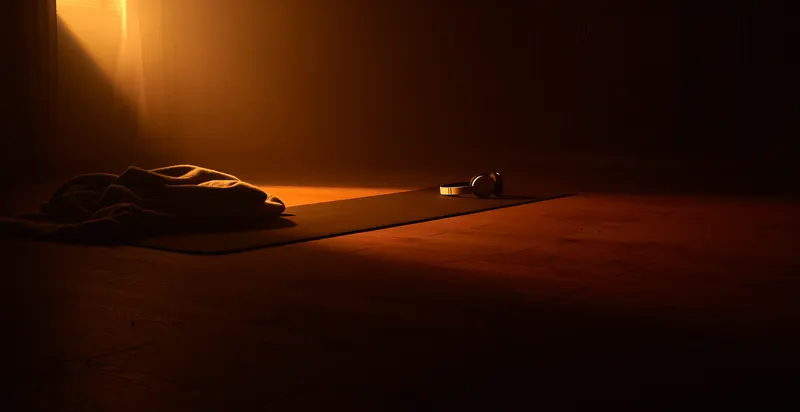
This is body-based work, not mind-based work. The breath does the heavy lifting. You lie down, put on headphones and an eye mask, and breathe. A trained facilitator holds the room. The soundscape carries you through.
Most people cry in a session. Some shake. Some laugh. Some go very quiet. Whatever needs to move, moves.
Different tools for different jobs
Meditation is brilliant at helping you become aware of what's happening in your mind. It teaches you to notice when you're spiralling, when you're catastrophising, when you're stuck in a loop.
Breathwork is brilliant at helping you release what's been stuck in your body. The anger you never got to express. The grief you never fully cried. The fear that froze mid-arc when you were too young to process it.
One makes you more conscious. The other moves what you've been unconsciously holding.
Both are valuable. They're just doing different work.
Why meditation alone isn't always enough
A lot of people who come to IMD have been meditating for years. They've read the books, done the apps, sat through the hard moments. And it's helped.
But something still feels off. A tightness that won't shift. A heaviness that sits in the body no matter how many hours they spend on the cushion. A sense that they understand what's wrong, but can't seem to change how they feel.
That's because understanding something and releasing it from the body are two different processes.
Say someone never got to cry at their father's funeral. The grief froze. Years later, they can meditate on that grief, think about it, become aware of it. But the stuck emotion is still in the body. It needs a body-based route out.
That's what breathwork does. It gives the body permission to finish what it started.
Meditation calms. Breathwork releases.
Here's another way to think about it.
Meditation helps you manage the surface. It steadies the boat. It teaches you not to react to every wave.
Breathwork goes underneath. It releases what's been stirring the water in the first place.
After a meditation session, most people feel calmer, clearer, more centred. The mind quiets. The nervous system settles.
After a breathwork session, most people feel lighter. Like something has physically left the body. The tightness in the chest loosens. The heaviness in the stomach shifts. Things that used to set them off don't land the same way.
Both are real. Both matter. But the feeling is different because the work is different.
You can do both
This isn't an either-or situation. A lot of people who come to our sessions also meditate. They use meditation to stay present and aware in daily life, and they use breathwork to release what meditation can't reach.
The two practices complement each other well. Meditation keeps you steady. Breathwork moves what's been stuck.
I've run sessions in London, Manchester, Amsterdam, New York, Los Angeles. The people who come have often tried everything: therapy, journaling, meditation, mindfulness apps. And those things helped them understand themselves better.
But the body was still holding something. Breathwork gave it a way out.
When to choose breathwork
If you've been meditating and it's working for you, keep going. There's no need to change anything.
But if you've been sitting with something for a long time and it still hasn't moved, if you feel like you understand what's wrong but can't seem to shift how you feel, if there's a tightness or numbness or heaviness that won't budge, breathwork might be the next step.
Meditation won't release stuck emotion from the body. It's not designed to. That's not a failing, it's just a different job.
Breathwork is designed for exactly that. To work with the body directly, to give emotion a route out, to help you release what you've been carrying so you can stop bracing and start living without the weight.
We run IMD Signature, the full two-hour session, and IMD Lite, a one-hour version. Both use the same method: conscious connected breathing, a custom-built soundscape, and a trauma-informed facilitator holding the room.
No prior experience needed. No need to have meditated before. You lie down, you breathe, and the session does the work.