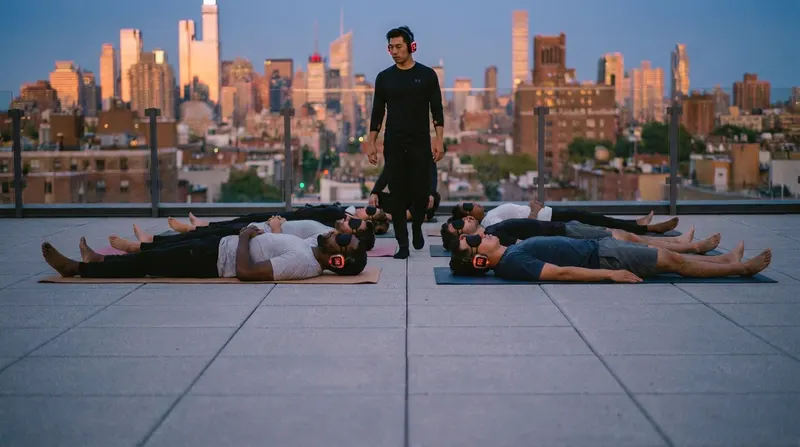

You're lying down. Breathing in a continuous pattern. And then it hits. Your chest tightens, your throat locks, and suddenly you're crying in a way you haven't cried in years. Maybe decades.
Most people don't expect it. They came to breathe, not to sob.
So why does breathwork make you cry?
Emotions you never finished feeling get stored in the body
When something painful happens and you can't feel it all the way through in that moment, the emotion doesn't disappear. It freezes. The body holds it.
Maybe you were too young to make sense of it. Maybe you weren't allowed to have the natural response. Maybe you had to keep it together because there was no other option.
The anger from years ago that you had to swallow. The grief you were never given space to cry. The fear from something that happened when you were too small to fight back or run.
Your body stored all of it. And it's still there.
This isn't a metaphor. Trauma research from people like Bessel van der Kolk and Peter Levine has shown that unprocessed emotion lives in the body as tension, numbness, or chronic activation. It shows up as a tight chest, a clenched jaw, a knot in your stomach that never quite goes away.
Most tools for emotional health work through the mind. Therapy helps you understand what happened. Mindfulness helps you notice what's happening now. Journaling helps you organise your thoughts.
Those are real work. But understanding an emotion is not the same as processing it.
To move emotion out of the body, you have to work with the body directly.
Breathwork shifts your physiology in a way that lets stored emotion surface
When you breathe in a continuous pattern with no pause between inhale and exhale, something shifts in your body's chemistry.
Your CO2 levels drop slightly. Your blood becomes more alkaline. Your sympathetic nervous system activates.
This quiets the thinking part of your brain while leaving the emotional part active. The part of you that talks yourself out of feeling drops away. What's underneath gets a route to the surface.
The breath doesn't create new emotion. It gives old emotion permission to finish the arc it never got to complete.
Say someone lost a parent young and never cried. Not because they didn't feel it, but because there was no space to fall apart. Maybe they had to look after siblings. Maybe the adults around them couldn't hold it. Maybe crying felt dangerous.
Decades later, that grief is still in the body. Held as tension in the chest, numbness where sadness should be, or an exhaustion that sleep doesn't fix.
During breathwork, the breath creates the conditions for that grief to move. The body finally gets to cry the tears it never cried. Not because the facilitator told them to. Not because they decided to. Because the body was holding it, and the breath gave it a way out.
Crying during breathwork is not the goal
A lot of people assume the point of breathwork is to cry. That the session is working if you sob, and failing if you don't.
That's not how it works.
The goal is release. Real, felt release where something that was stuck actually moves. For some people, that looks like crying. For others, it's laughter. For others, shaking. For others, going completely still and quiet.
Whatever needs to move, moves.
Crying is one way the body completes an emotional arc. But it's not the only way, and it's not the most important part of the session.
The most important part is what happens after the emotion moves. The body learning, on a felt level, that it's safe to feel what it just felt. The nervous system settling. The integration.
That's what makes the change last.
What crying actually feels like during a session
If you do cry during breathwork, it often doesn't feel like everyday crying.
It's not crying about something. It's crying that comes from somewhere deeper. Older.
Sometimes people know exactly what's moving. They see the moment, the person, the thing they never got to grieve. Other times, they have no idea why they're crying. They just know something is leaving.
The tears can be quiet or loud. They can come in waves or all at once. They can feel like relief or like something breaking open that's been locked for years.
Most people describe it as cathartic. Not in the dramatic sense, but in the sense of finally finishing something.
Not everyone cries
Plenty of people come to IMD breathwork sessions and don't cry at all.
Some people laugh. Some people feel anger move through their body and leave. Some go into a deep, quiet stillness. Some feel their chest open for the first time in years without any tears at all.
The body releases what it needs to release, in the way it needs to release it.
If you come to a session hoping to cry and nothing happens, that doesn't mean the session didn't work. It means your body needed to do something different that day.
Why IMD sessions are built the way they are
At IMD, every part of the session is designed around one thing: giving the body a safe route to release what it's been holding.
You lie down, put on headphones and an eye mask, and breathe in a continuous pattern. A trained facilitator holds the room. A custom-built soundscape carries you through the arc of the session.
The music isn't background. It's doing as much of the work as the breath. The tempo, the tone, the structure are all chosen to drop you out of your thinking mind and into the part of you where stuck emotion actually lives.
The session follows a deliberate progression. A beginning, a peak, a return. The body moves through a natural arc: the breath builds, things surface and move at the peak, and the system comes back down.
The last 20 minutes are the IMD Landing. The breath softens, the music shifts, and you're guided through two visualisations. This is when the body's natural recovery state kicks in. What moved during the session gets a chance to integrate.
That's what makes the release land. That's what makes it last.
We run IMD sessions in cities across the world: Dubai, Abu Dhabi, Riyadh, Muscat, Amman, Beirut, Singapore, Kuala Lumpur, Jakarta, Hong Kong, Mumbai, Karachi, Johannesburg, Hermanus, Knysna, Manchester, Birmingham, Brasov, Brisbane and the Gold Coast. Cape Town, Colombo and Melbourne are coming soon.
After the session
Most people leave feeling lighter. Calmer. More like themselves.
If you cried during the session, you probably won't feel drained afterwards. You'll feel clearer. The tightness that was in your chest might be gone. The heaviness might have lifted.
Many people notice small shifts in the days and weeks that follow. Things that used to set them off don't land the same way. Behaviours that felt forced get easier. The charge comes off old triggers.
That's what happens when emotion that's been stuck for years finally moves.
Breathwork doesn't make you cry. It gives your body permission to cry the tears it's been holding. And when those tears finally come, something shifts.